Visit our Exhibition in Washington, DC: Jan 27 - Oct 14, 2012
Jefferson’s Monticello - Home Explore Plantation & Slavery companion websites
  • Get Email Updates
  • Sign-in
Landscape of Slavery: Mulberry Row at Monticello
  • Explore Topics
  • Meet People
  • Discover Work
  • View Places
  • Gallery
  • Visit Mulberry Row
AddThis Sign-in to Favorite Share Print
< back to Meet People

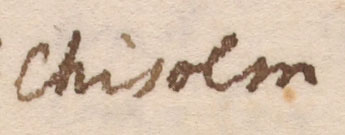
Hugh Chisholm

MaleHired White WorkersWork: Mason, Carpenter, Bricklayer

Massachusetts Historical Society

Hugh Chisholm was a hired white workman, a jack of all trades, employed at Monticello from 1796 to 1797 and from 1801 to 1814.  Jefferson “paid Chisolm for plaistering &c.,” as well as for masonry, carpentry, bricklaying, and “20.D. to pay for digging.”¹  Sometimes working with his brother, bricklayer John, he “moulded and burnt” clay to make bricks and with “2 apprentices … [could] lay 1600. bricks a day.”²  Chisholm worked on Monticello II (1796-1809), the dependencies, cisterns , and the South Pavilion. He may have renovated the workmen’s house on Mulberry Row when it was converted from dwelling to textile workshop. Chisholm owned a slave, Lewis, to whom Jefferson paid small sums for occasional odd jobs, such as “Chisolm's Lewis gratuity for cistern 1.D." in 1821.³

Read more at Monticello.org»

  1. Jefferson's Memorandum Books, Sept. 14, 1810, vol. II: 1260 and Sept. 25, 1806, vol. II: 1188.
  2. Thomas Jefferson to Hugh Chisholm, Dec. 15, 1807. 
  3. Jefferson's Memorandum Books, Sept. 29, 1821, vol. II: 1379.


Related Links

Plantation & Slavery

Tags

None
Login or register to tag items

Add comment

Login or register to post comments

E. workmen's house

Explore the workmen’s house, a structure that served as a dwelling and textile workshop during Jefferson’s lifetime. More »

Take a Tour

Visit Mulberry Row at Monticello

Learn about the enslaved people who lived and worked on Mulberry Row, the dynamic industrial hub of the Monticello plantation. More »

Jefferson’s Monticello - Home
Facebook YouTube Twitter Flickr
  • Home
  • About
  • Press
  • Donate
  • Sponsors
  • Explore Topics
    • Treatment
    • Economy
    • Labor
    • Skills
    • Resistance
    • Family
    • Picturing Mulberry Row’s People
  • Discover Work
    • Sawing
    • Rough Carpentry
    • Joining
    • Charcoal-burning
    • Tinsmithing
    • Nail-making
    • Spinning and Weaving
    • Tending of Horses
    • Preservation of Meat
    • Dairying
    • Laundering
    • Blacksmithing
  • View Places
    • Phase I (1769 – 1790)
    • Phase II (1791 – 1809)
    • Phase III (1810–31)
  • About
    • Credits
    • Press
    • Sponsors
    • Donate
    • Visit Mulberry Row
monticello.org UNESCO World Heritage List