Jefferson's Bookmarks
Thomas Jefferson had a peculiar way of marking his ownership of his books that took advantage of common printing practices of his day.

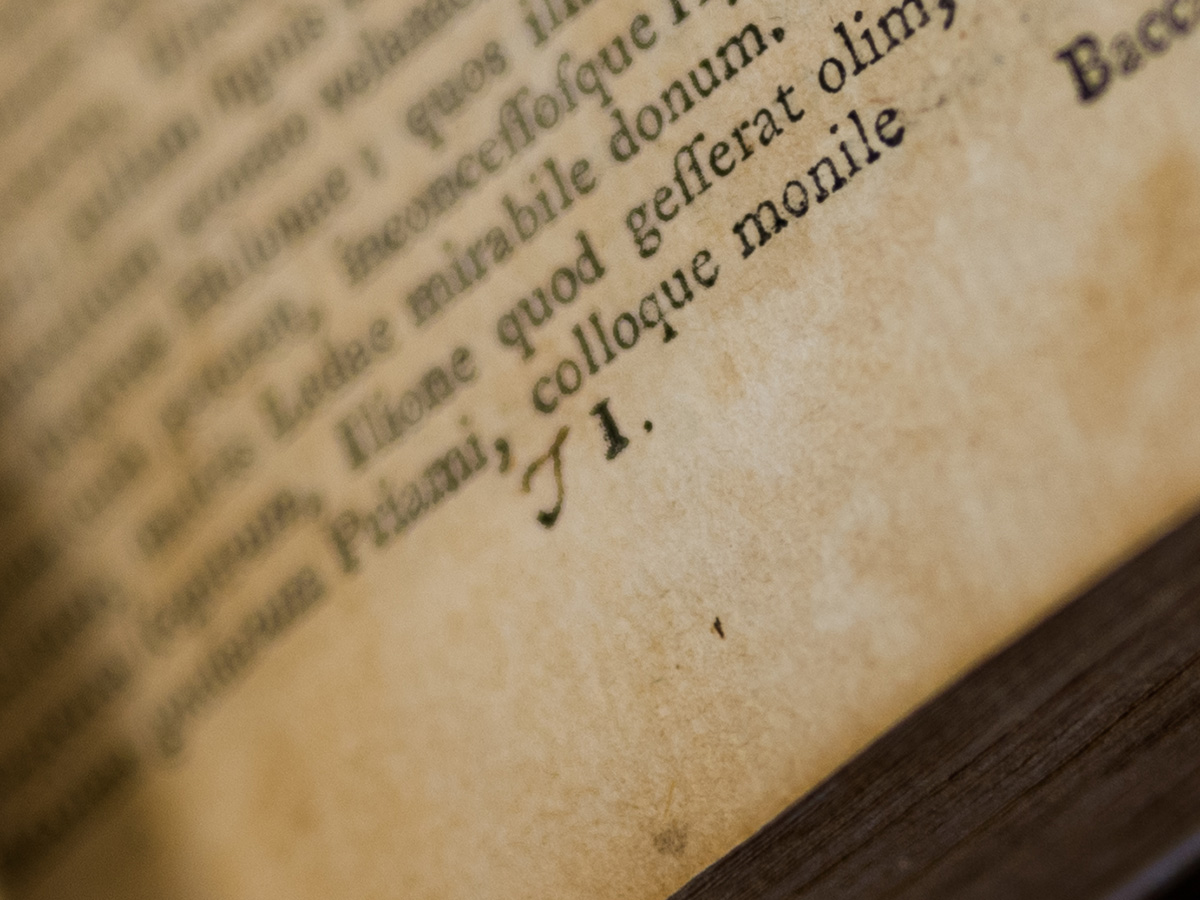
In order to understand Thomas Jefferson's method of marking his books, one needs to know a few details of book production in Jefferson's day.
Books are printed not leaf by leaf but on a large sheet of paper with a number of pages on each side. After printing, the sheet is folded into the appropriate format for the book: once for a folio (producing two leaves); twice for a quarto (four leaves); three times for an octavo (eight leaves); and so forth. The folded sheet is called a quire or gathering. The finished book consists of all the gatherings sewn together and bound. To assist the binder, the printers "sign" each gathering with a letter of the alphabet, printed below the text in the tall margin. This printer's mark is called the signature. By keeping his eye on the signatures, the binder arranges all the quires or gatherings in alphabetical order, quickly getting a book into final form.

The common practice among printers in Jefferson's day was to use the 23-letter Latin alphabet for signatures (an old tradition from the early days of printing). This meant that the letters J, U, and W were omitted. With this in mind, one should find Jefferson's practice less puzzling. To identify the books in his library, Jefferson wrote a cursive T before the I-signature and a cursive J after the T-signature (shown here in William Peere Williams's Report of Cases Argued and Determined in the High Court of Chancery). After 1815, when he sold his collection to Congress, he wrote a block T after the I-signature and a block I (the Latin equivalent of J) after the T-signature.
-Russell L. Martin, 4/88