Moldboard Plow
Thomas Jefferson considered his design for a "Moldboard Plow of Least Resistance" one of his more important contributions to agriculture in his time.

A recreation of Jefferson's "Moldboard Plow of Least Resistance" based on his original drawing; photographic image (c) Thomas Jefferson Foundation.
Thomas Jefferson had an abiding interest in improving the technology of farming. One of his more important contributions to agriculture was the "mouldboard of least resistance" for a plow.1
While serving as minister to France, Jefferson had the opportunity to observe European plow designs. Their deficiencies inspired him to set down in a 1788 memorandum his plans for an improved moldboard, the wooden part of the plow that lifts up and turns over the sod cut by the iron share and coulter.2 He wished to make that lifting and turning action as efficient as possible, so that the plow could be pulled through the soil with the least expenditure of force. He brought his love of mathematics to his design, which he declared was "mathematically demonstrated to be perfect."3
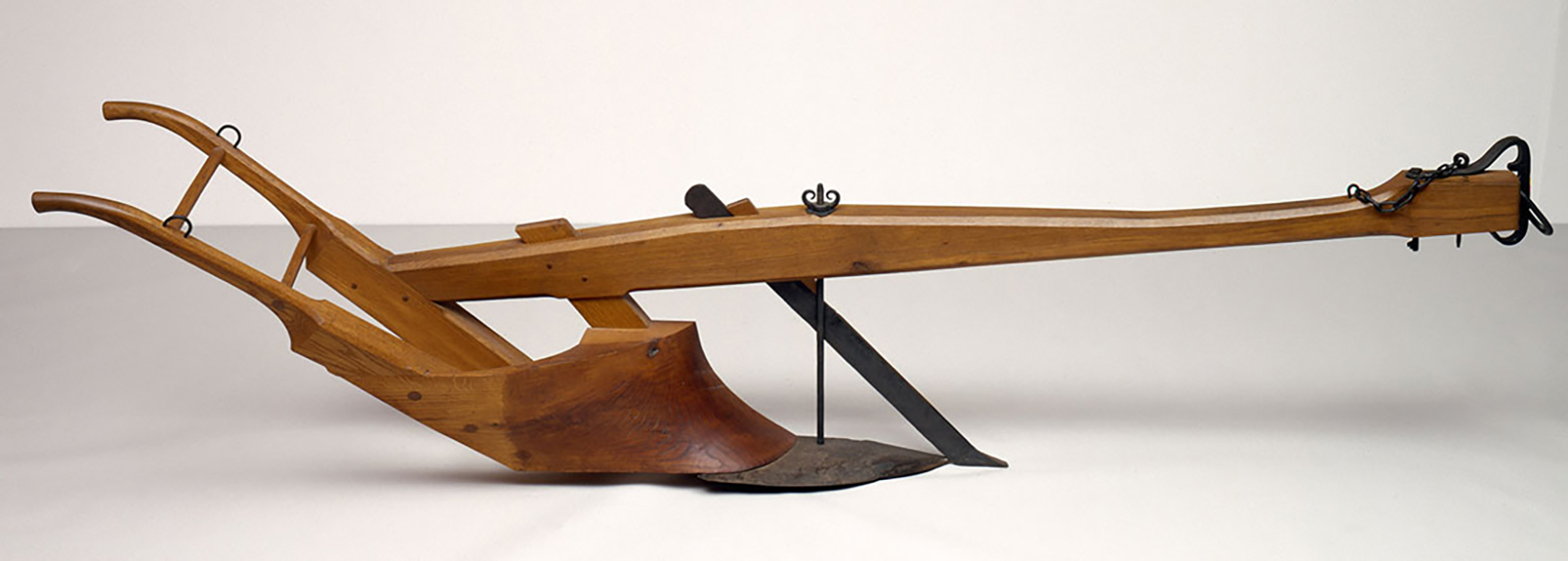
By 1794, Jefferson had put his plans into action at Monticello. He had a plow fitted with a wooden moldboard of his design and later reported to Sir John Sinclair that "an experience of 5. years has enabled me to say it answers in practice to what it promises in theory." In addition to offering the least resistance as it was pulled through the soil, Jefferson's moldboard had a further advantage: "[I]t may be made by the coarsest workman, by a process so exact, that it's form shall never be varied a single hair's breadth." Ease of duplication was thus another measure of the usefulness of his design.4

Jefferson's blueprint drawing of the Moldboard Plow of Least Resistance; image courtesy Library of Congress Manuscripts Division.
In 1814, Jefferson began to have his moldboards cast in iron. He informed Charles Willson Peale that the plow with his iron moldboard was "so light that two small horses or mules draw it with less labor than I have ever before seen necessary. it does beautiful work and is approved by every one."5
Just how widely Jefferson's moldboard was adopted by others is unclear. He never sought to patent it, and in fact sent numerous models to friends at home and abroad, where his design met with general approval. Jefferson's moldboard was featured in James Mease's Domestic Encyclopedia (Philadelphia, 1803), and the French Society of Agriculture awarded Jefferson its gold medal and membership as a foreign associate.6
- Russell L. Martin and Lucia C. Stanton, 10/88
Further Sources
- Betts, Edwin M., ed. Thomas Jefferson's Farm Book: With Commentary and Relevant Extracts from Other Writings. Princeton: Princeton University Press, 1953; reprint 1999. See pages 47-64. Manuscript and transcription available online at Coolidge Collection of Thomas Jefferson Manuscripts, Massachusetts Historical Society.
- Betts, Edwin M., ed. Thomas Jefferson's Garden Book, 1766-1824: With Relevant Extracts from His Other Writings. Philadelphia: American Philosophical Society, 1944; reprint 1999. See pages 649-54. Manuscript and transcription available online at Coolidge Collection of Thomas Jefferson Manuscripts, Massachusetts Historical Society.
- Willich, A.F.M., and James Mease. The Domestic Encyclopaedia, or, A Dictionary of Facts, and Useful Knowledge.... Philadelphia: W.Y. Birch and A. Small, 1803-1804. See volume 4, pages 288-92 (see especially illustration facing page 289 of "Sections of Mr. Jefferson's Mould-Board").
- Wilson, M.L. "Jefferson and His Moldboard Plow." Land 3 (1943): 59-64.
Footnotes
- See Jefferson to Jonathan Williams, July 3, 1796, in PTJ, 29:140. Transcription available at Founders Online.
- See Notes of a Tour through Holland and the Rhine Valley, March 3 – April 23, 1788, in PTJ, 13:27. Transcription available at Founders Online.
- Jefferson to John Taylor, December 29, 1794, in PTJ, 28:233-34. Transcription available at Founders Online.
- Jefferson to Sinclair, March 23, 1798, in PTJ, 30:201-05. Transcription available at Founders Online.
- Jefferson to Peale, March 21, 1815, in PTJ:RS, 8:367. Transcription available at Founders Online.
- See A.F.M. Willich and James Mease, The Domestic Encyclopaedia, or, A Dictionary of Facts, and Useful Knowledge.... (Philadelphia: W.Y. Birch and A. Small, 1803-1804), 4:288-92. See also Jefferson to Pierre Samuel Du Pont de Nemours, February 12, 1806, Thomas Jefferson Papers, Library of Congress. Transcription available at Founders Online.