Encyclopedia
1796 Mutual Assurance Plat
A plat by Jefferson with detailed descriptions and sketches of the main house, South Pavilion, and structures along Mulberry Row.
Articles about the Monticello house and its features, dependencies, and design.
page 1 of 4
A plat by Jefferson with detailed descriptions and sketches of the main house, South Pavilion, and structures along Mulberry Row.
Completed by 1809, Monticello's best-equipped kitchen was the domain of enslaved chefs Edith Fossett and Frances Hern, who brought French-trained culinary expertise to the mountain after serving at the White House.
Jefferson was "much attached" to alcove beds and incorporated them into nearly every bedroom during his redesign of Monticello in the 1790s.
Apart from Jefferson's "habit of bathing my feet in cold water every morning," little is known about bathing practices at Monticello.
Explore the bed chamber in Monticello and its importance to Jefferson's personal life.
Benjamin Ficklin, an entrepreneur and adventurer credited with creating the Pony Express, briefly owned Monticello in the Civil War era.
Find out how Jefferson felt about the game billiards and its role at Monticello during the Levy ownership of the property.
Read references to blinds and shutters in Jefferson's letters and records.
Learn about Thomas Jefferson's personal study or Cabinet, where Jefferson read, wrote correspondence, and performed scientific observations.
The second-floor Nursery at Monticello was a bedroom and caregiving space for a number of Jefferson's grandchildren.
Jefferson had four cisterns installed at Monticello to collect rainwater and alleviate ongoing issues with supplying water to his mountaintop home.
Find out about the clever and ingenious methods Thomas Jefferson used to cool and ventilate Monticello.
The true cost of building Monticello has never been calculated. Jefferson's own records offer some clues, but variables like enslaved labor and bartered materials make a definitive figure impossible to determine.
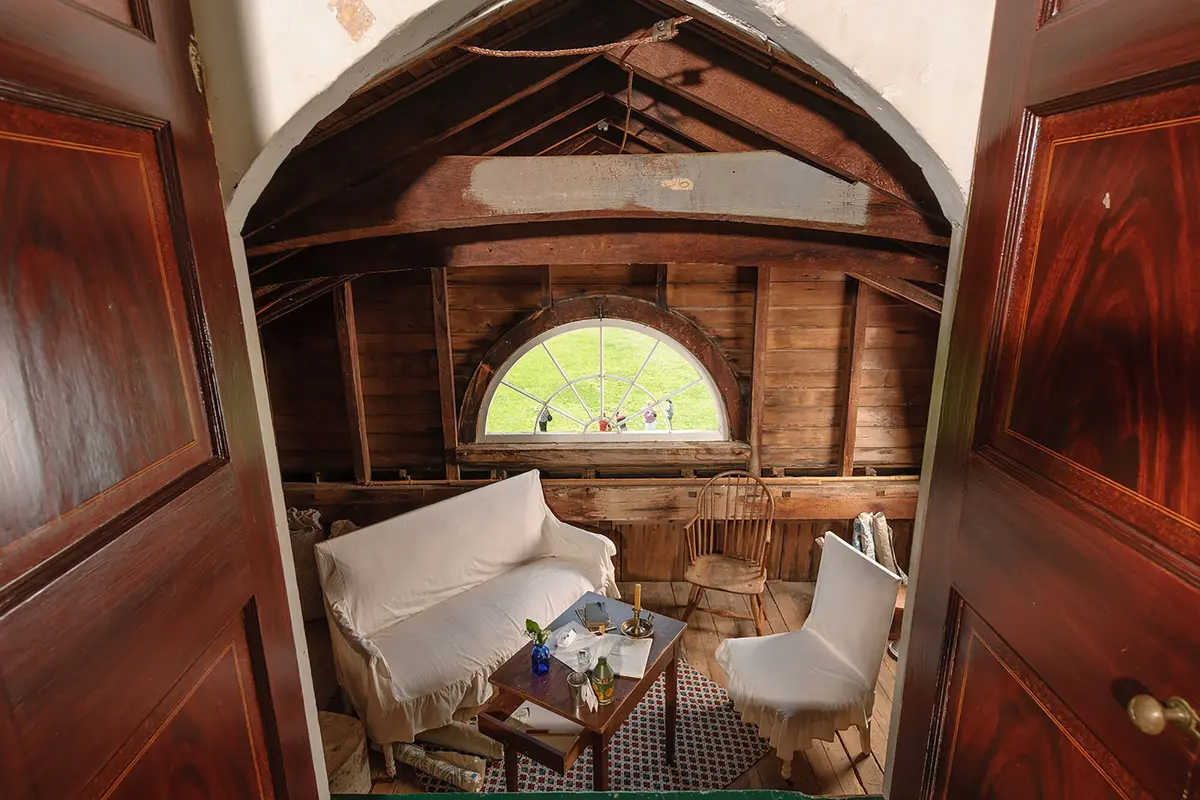
Jefferson's granddaughters claimed this tucked-away attic space beside the Dome Room as their own private retreat, nicknaming it the "Cuddy" after a small nook found on a ship.
David Watson was a hired white craftsman who worked at Monticello in the 1780s and 1790s.
An overview of Monticello's Dining Room where Thomas Jefferson entertained guests with lively conversation, wine, and food served in "half French, half Virginian style."
Learn more about the design and history of Monticello's iconic third-floor Dome Room.
Find out why -- and how -- dumbwaiters, which Jefferson saw in Paris, were used in Monticello's Dining Room.
The "First Monticello" (sometimes called "Monticello I), refers to the house as it existed during the period extending roughly from 1770 to 1796.
An annual edition of the Magazine of Albemarle County History had some special visual goodies.
The fish ponds at Monticello served as practical and convenient resources for storing live fish for Jefferson's table.
A complete list of more than 100 free workmen employed at Monticello during Jefferson's ownership, including their trades — from masons and carpenters to gardeners and millers — and years of service.
Jefferson specially imported Chinese gongs to serve as bells at Monticello — one was used to sound the hours on the Great Clock, and its distinctive tone could be heard across the farm.
A second floor bedroom occupied at different times by several of Jefferson's granddaughters.