Andrew Tribble
The story that an encounter with Andrew Tribble about Baptist theology influencing Jefferson's views on democracy has persisted since Jefferson's death in 1826.
Articles on Jefferson's views on religion and religious freedom written by Monticello researchers and scholars.
The story that an encounter with Andrew Tribble about Baptist theology influencing Jefferson's views on democracy has persisted since Jefferson's death in 1826.
In 1814, Jefferson privately contributed $50 to the Bible Society of Virginia in support of the distribution of Holy Bibles to households that could not afford one.
A look at Thomas Jefferson's views on establishing a national day of thanksgiving and prayer in relation to his belief in religious freedom.
Why the Virginia Statute for Establishing Religious Freedom is the key to political freedom and free thought.
The Elementary School Act, Thomas Jefferson's "Bill for Establishing Elementary Schools," was proposed legislation that was never officially adopted.
Elihu Palmer (1764-1806) was an American deist philosopher who rejected orthodox Christianity and formed the deistical New York Theistical Society.
Frederick Hatch was an Episcopal minister in Charlottesville, Virginia who ran a school that some of Thomas Jefferson's grandsons attended.
A look at Thomas Jefferson's lifelong interest in the science of geology.
A Christian, a deist, or an atheist? Thomas Jefferson’s religious beliefs have long been a subject of public discussion and controversy,
Explore this list of references Monticello researchers compiled about Thomas Jefferson's writings on Jews and Judaism.
Abbé José Correia da Serra of Portugal was a close friend of Thomas Jefferson and frequent visitor to Monticello, where the two shared wide-ranging interests in science, nature, and learning.
“Notes on the State of Virginia,” the only book Jefferson wrote, was both well-regarded and controversial. Frequently reprinted in his lifetime, “Notes” is a tour d'horizon of Jefferson's interests and ideas on a wide range of subjects.
Find out why Jefferson owned a copy of the Koran in his library at Monticello.
Find out why researchers think Jefferson never wrote or said "The Bible is the source of liberty."
A reprint with facsimile pages from Jefferson's 1819 original book.
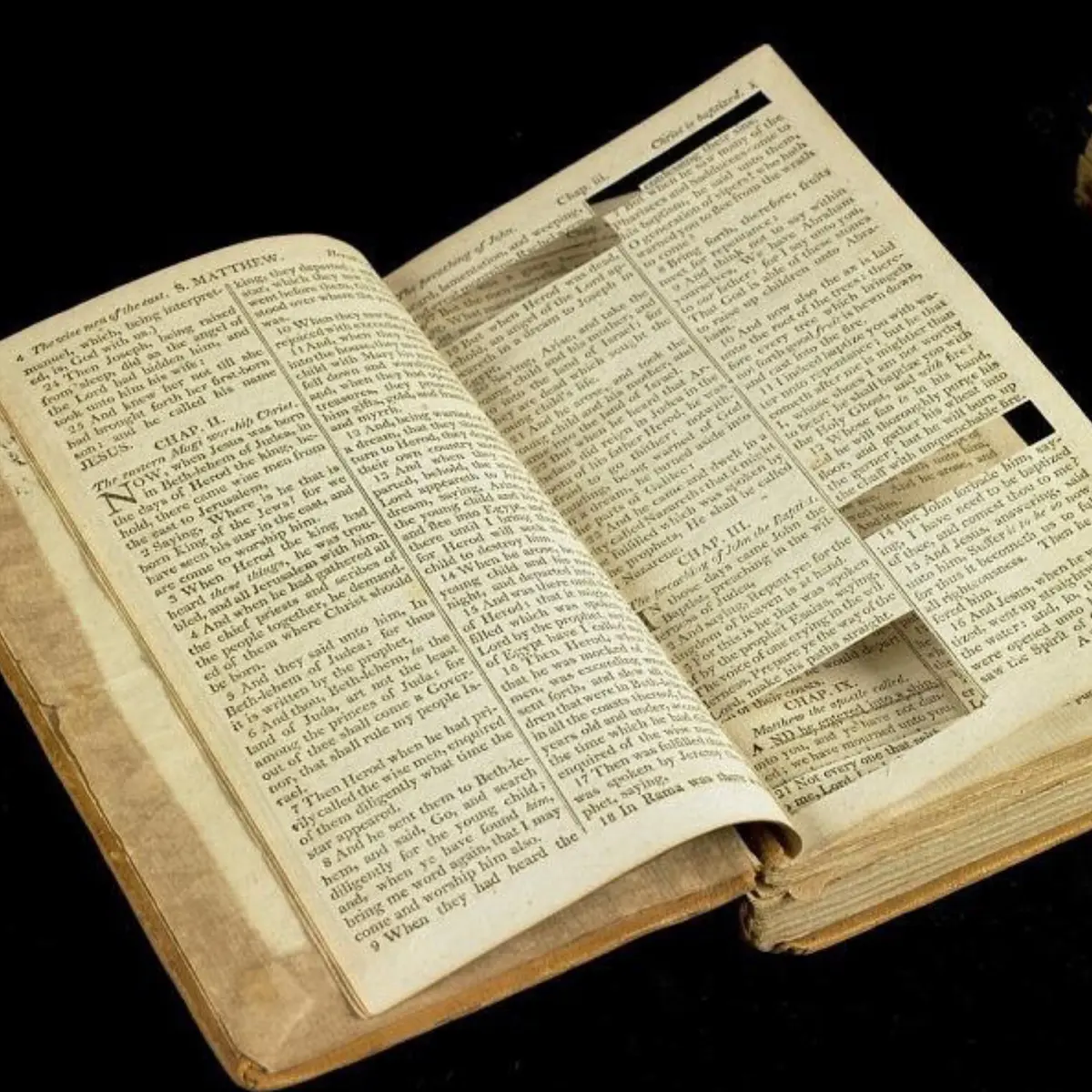
A look at why Jefferson cut apart a bible to create his own bound version of the Gospels, now often referred to as The Jefferson Bible.
Jefferson's 1st attempt to distill the original tenets of Christianity, "The Philosophy of Jesus of Nazareth," became part of what is now called The Jefferson Bible.
Jefferson championed religious freedom, wrote Virginia's Statute for Religious Freedom, and described the "wall of separation" between Church and State.
A U.S. Navy officer and significant character in Jewish-American history who purchased Monticello to preserve it in Jefferson's memory
Thomas Jefferson wrote the Statue of Virginia for Religious Freedom and considered it one of his three greatest achievements.