
Building Access, Revealing History
Archaeologists uncovered a previously undocumented brick kiln on Monticello's East Lawn during construction of new accessible pathways — the first physical evidence of brick production on the mountaintop

A new network of accessible footpaths is being created at Monticello to help connect guests to the full story found across the historic Mountaintop. The first section of the pathways, connecting the East Front of the Main House with the South Wing, Mulberry Row, and the shuttle stop, opened to guests this past spring.
Before any construction begins on the historic property, Monticello's Department of Archaeology works to protect historic resources, document findings, and advance our understanding of how the mountaintop landscape was created, functioned, and changed over time. Led by Crystal O'Connor, Archaeological Field Research Manager, the team spent a year exploring the layers of sediment deposited during the construction of Monticello. Although the landscape may look "natural," it has a complex history of design and redesign by Jefferson. Enslaved and free workers constructed Monticello in phases, starting with the leveling of the mountaintop in 1768. "We're still learning about the evolution of this mountaintop and the layers," says O'Connor. "The artifacts and layers of dirt that we find help us understand how the mountaintop was sculpted and created over 40 years."
One particularly exciting discovery occurred in late March, when archaeologists uncovered the remains of a previously undocumented brick kiln on the East Lawn. The find emerged during work ahead of the new pathway construction, when an apparent scatter of bricks revealed something far more significant. "We thought we were looking at a pile of brick rubble," says O'Connor. "But once we cleaned the surface and the light hit it just right, we started to see these alignments. That's when the pieces fell into place."
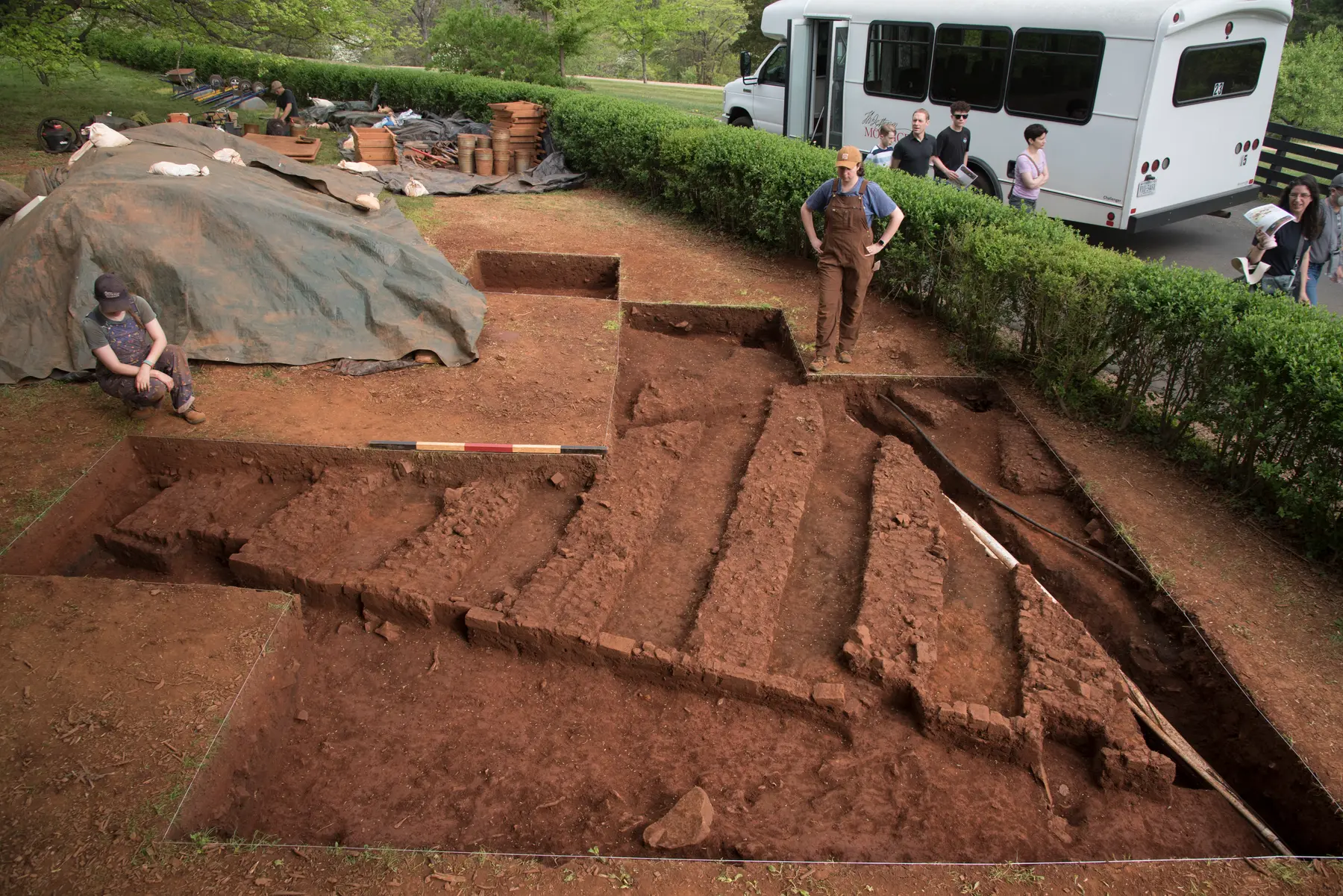
Careful excavation exposed multiple aligned rows of bricks and fire channels of a kiln, operated by hired brickmakers and enslaved laborers to fire bricks in the early 1770s. The discovery marks the first physical evidence of brick production on the mountaintop itself, offering new insight into the construction of Monticello's earliest phase.
Specialty bricks found at the site — molded forms used in the dining room's exterior water table where they help shed water away from the foundation — proved critical in dating the kiln. Because these bricks appear only on that portion of the house, they link the kiln directly to the construction of Monticello I, the original house built in the early 1770s. The later expansion known as Monticello II, undertaken in the 1790s after Thomas Jefferson returned from France, did not use these decorative elements, allowing archaeologists to distinguish between the two building phases. By the time construction began on Monticello II, the brickmaking operation had been moved to the base of the mountain.
The kiln has been reburied to protect it, but not before it was thoroughly documented using photography, detailed mapping, and advanced tools such as photogrammetry and 3D scanning.
"This discovery is a reminder that we're not done learning about Monticello," says O'Connor. "There's still more research to be done, more stories to uncover, and more to share about the people who lived and labored here."
Monticello Magazine, Spring/Summer 2026
