
Publish and Declare – The People Learn the News
An excerpt from “When the Declaration of Independence Was News” by Emily Sneff

Many people in the United States — beginning in Philadelphia — learned about the Declaration of Independence through public readings and printed broadsides and newspapers. After John Dunlap produced the first broadsides of the text, he and his fellow printers published the Declaration in their respective newspapers. One Philadelphia bookseller even added the Declaration as an appendix to an anonymous pamphlet already on the printing press. German printers in Philadelphia produced the first translations of the Declaration within days of July 4. The Pennsylvania Committee of Safety scheduled the first public readings of the Declaration for an election day, when the men who were eligible to vote would decide who would craft a new constitution for the commonwealth. By the time the constitutional convention began on July 15 in Philadelphia, the Declaration was no longer news in the city. It moved on to other places, the columns of other newspapers, and readings in other public squares.
From July through mid-August 1776, the Declaration of Independence was printed and proclaimed across the United States. Many public readings followed a formula that was familiar from years of civic celebrations for King George III and his predecessors, but with a few decidedly different elements. In town after town, civilians and soldiers assembled outside of a courthouse or another central location. A local official, oftentimes the sheriff, read the Declaration aloud, and when he reached the end of the text the people responded with cheers and the soldiers fired off a salute. The celebration often stretched into the evening, lit by bonfires fueled by the wooden coats of arms and signs and symbols of the British crown that were taken down from the buildings around town. People also read the Declaration in private, in their local newspaper or broadsides that some printers made available to purchase.
The Declaration promoted a new national identity and sense of purpose. The process of publishing the news of independence drew people together but also ostracized people who did not want to openly support independence. And, in their haste to spread the news, printers made mistakes — some innocuous but some surprising for a text as important in hindsight as the founding document of the United States.
The first printer of the Declaration of Independence was John Dunlap. When he was young, Dunlap immigrated from County Tyrone in Northern Ireland to Philadelphia. He learned the printing trade from his uncle, and by 1776 he had been running his own business for a decade. Dunlap had printed many resolutions for the Continental Congress, but the resolution that the Congress asked him to print on July 4 was different.
In his office at the southeast corner of Second and Market Streets, Dunlap set to work on a large broadside of the Declaration. He relied on a clean, handwritten copy of the Declaration as approved by the Congress, and he may have been supervised by one or more members of the drafting committee. Dunlap did not work alone, and he did not work perfectly. A peculiar fragment of one of his broadsides has strange marks ( ‘ ‘ ) around certain phrases in the first two paragraphs. Perhaps these marks had been inadvertently left on the manuscript that Dunlap was copying, and whoever set the type had initially thought that they were part of the text but then removed them from the typesetting.
On July 5, the President of the Continental Congress, John Hancock, and his private secretary, Jacob Rush, began to send out copies of the Declaration. Hancock and Rush enclosed Dunlap broadsides in letters to Continental Army generals with instructions to proclaim independence to the soldiers who were actively fighting for it. They also sent Dunlap broadsides to governors, conventions, assemblies, and committees of safety in the different states. Six weeks after the May 15 Resolution, the United States were still figuring their governments out, and the Congress recognized this reality. Hancock directed each of these authorities to share the Declaration of Independence with their "Colony" — a slip of outdated language — "in such Way & Manner as you shall Judge best." As Hancock told these leaders of the United States, "important Consequences" would flow from the Declaration of Independence, and it was essential "that the People may be universally informed of it."

Produced in Philadelphia on July 4, 1776, the Dunlap Broadside was the first printed version of the Declaration of Independence.
In these early days, the Declaration of Independence was treated as the product of the Continental Congress. Unlike Common Sense and other pseudonymous essays, there was no public speculation about who had authored the Declaration. Only John Dunlap's Baltimore newspaper reported that the Declaration was "the production of an eminent Gentleman of Virginia." But Thomas Jefferson wanted his friends to see the Declaration as he had intended it, and he put his own publication plan in motion. Jefferson created clean handwritten copies of the draft that the Committee of Five had presented to the Congress and sent these manuscripts from Philadelphia to Virginia — to Richard Henry Lee and George Wythe, who had taken leave of the Congress to work on Virginia's new constitution, but also to Edmund Pendleton, John Page, and Filippo Mazzei, Jefferson's Albemarle County neighbor. Jefferson asked his friends to "judge" whether the final Declaration was "better or worse for the Critics." Although Lee had not witnessed the editing sessions in the Committee of the Whole firsthand, he could see that the Congress had "mangled" the committee draft. Edmund Pendleton agreed with Lee's assessment, and told Jefferson that the Congress had "altered it much for the worse." "However," Lee assured Jefferson, "the Thing is in its nature so good, that no Cookery can spoil the Dish for the palates of Freemen." The Congress had declared independence, and that was what mattered most.
As the Declaration of Independence started to spread throughout the United States, only a handful of people knew how the Committee of the Whole had changed what the drafting committee had proposed. Thirty years later, when Thomas Jefferson was President of the United States, a new generation of newspaper readers would see the draft Declaration for the first time. In 1806, George Wythe was poisoned to death by his grand-nephew, and his papers — including the copy of the draft Declaration that Jefferson had sent to Wythe — ended up in the hands of the editor of the Richmond Enquirer, who was eager to print it. In 1776, the vast majority of the people who read the Declaration had no idea that the text had been drafted and revised by Jefferson, edited by John Adams, Benjamin Franklin, and perhaps Roger Sherman and Robert R. Livingston, and then refined and amended by all the delegates in Philadelphia.

On loan from David M. Rubenstein, this rare copy of the Declaration of Independence is part of Monticello’s new exhibition, 1776: Journey to the Declaration. In 1823, printer William J. Stone produced 201 exact copies of the original Declaration, complete with signatures. One of fewer than 50 examples surviving today, this document originally belonged to James Madison.
In the weeks that followed July 8, there were dozens of public readings of the Declaration. Sheriffs were the officials most often asked to read the text aloud, and courthouses were the most popular locations. Many of these readings were described in newspapers, and the accounts were reprinted across the United States. In his Pennsylvania Packet, John Dunlap described public readings of the Declaration in New Jersey, New York, New Hampshire, Massachusetts, Maryland, and South Carolina. These accounts reassured the Continental Congress that the Declaration of Independence was being well received. The same sorts of descriptions of its reception recur in many different settings. The celebrations at the college in Princeton, New Jersey, the state house in Newport, Rhode Island, and the courthouse in Richmond, Virginia, were all "conducted" with great "decorum." The reading of the Declaration in Newburyport, Massachusetts, was a "joyful occasion," and the soldiers at Fort Ticonderoga, New York, "manifested their joy with three cheers." Learning about these readings and seeing similarities between celebrations in different places reinforced a sense of community and common purpose in the new nation.

The readings of the Declaration of Independence in the first few weeks of July were confined to the northern and mid-Atlantic sites because it took more time for the post to travel by land to the southern states. Ordinarily, it would have been easier for a ship to carry the news of independence to the Carolinas and Georgia, but there were British ships all along the coastline, and the key port of Charleston had narrowly escaped British occupation. When the Declaration of Independence was news, it was fleeting. Public readings — even the all-day series of readings in Charleston and Savannah — were momentary. They offered people an opportunity to come together, listen to one voice for about ten minutes, and perhaps participate in toasts and cheers before going back to their everyday activities. The newspaper columns that contained the Declaration of Independence in one issue contained completely different news in the next issue, arranged from the same pieces of metal type. Nevertheless, the common experience of the news of independence would have a lasting impact.
Monticello Magazine, Spring/Summer 2026
When the Declaration of Independence Was News

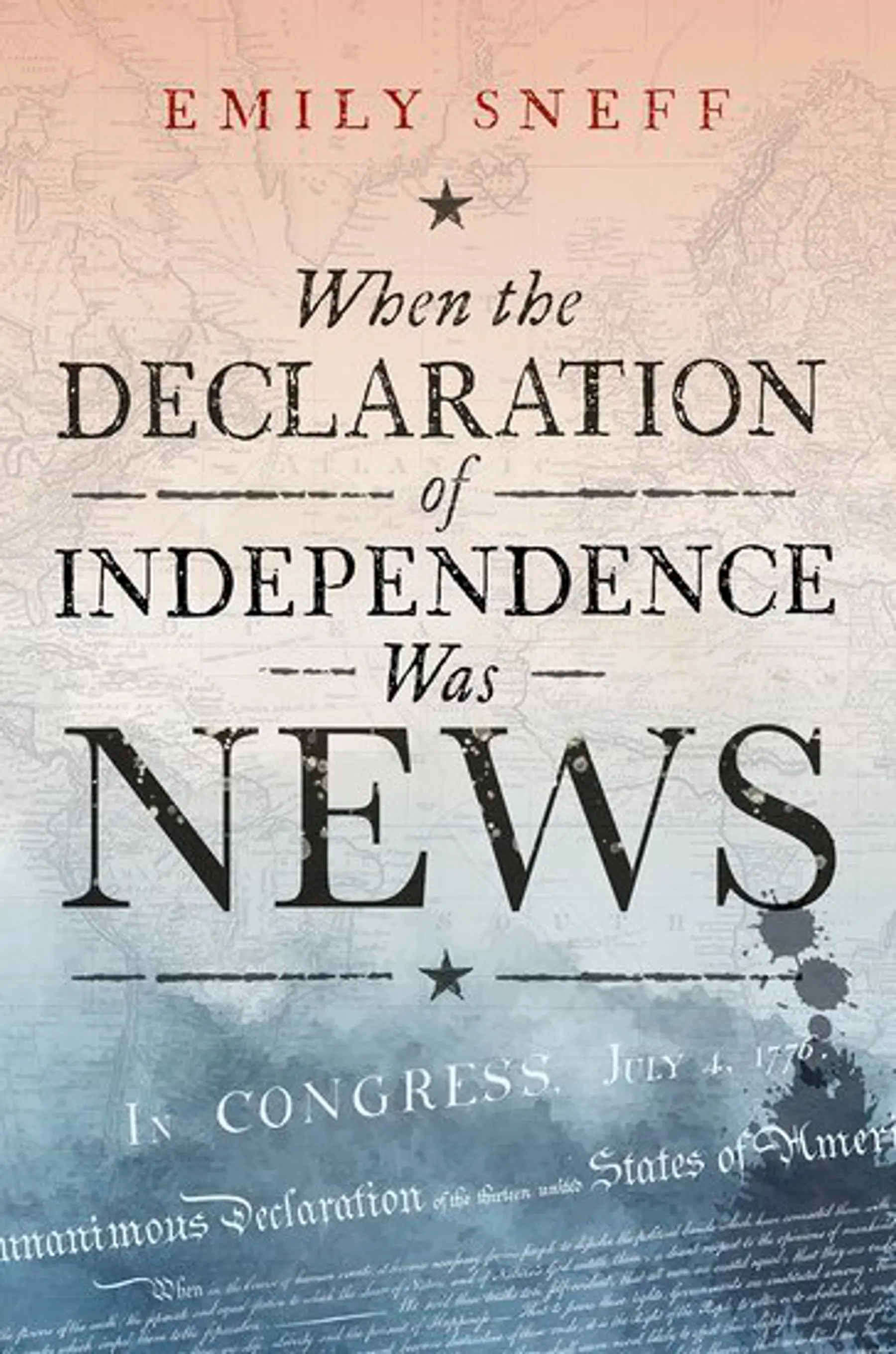
In her new book, historian Emily Sneff shows how America’s founding document spread in real time through broadsides, newspapers, translations, and public readings. Her book follows printers, soldiers, diplomats, and translators as they turned a congressional vote into a shared civic event across the Atlantic World.
Sneff reframes the Declaration not as a single fixed document, but as a rapidly circulating piece of news that was printed, read aloud, translated, and debated across the new nation.