Joe-Pye Weed
Eupatorium purpureum
A handsome North American member of the Aster family; attracts pollinators.
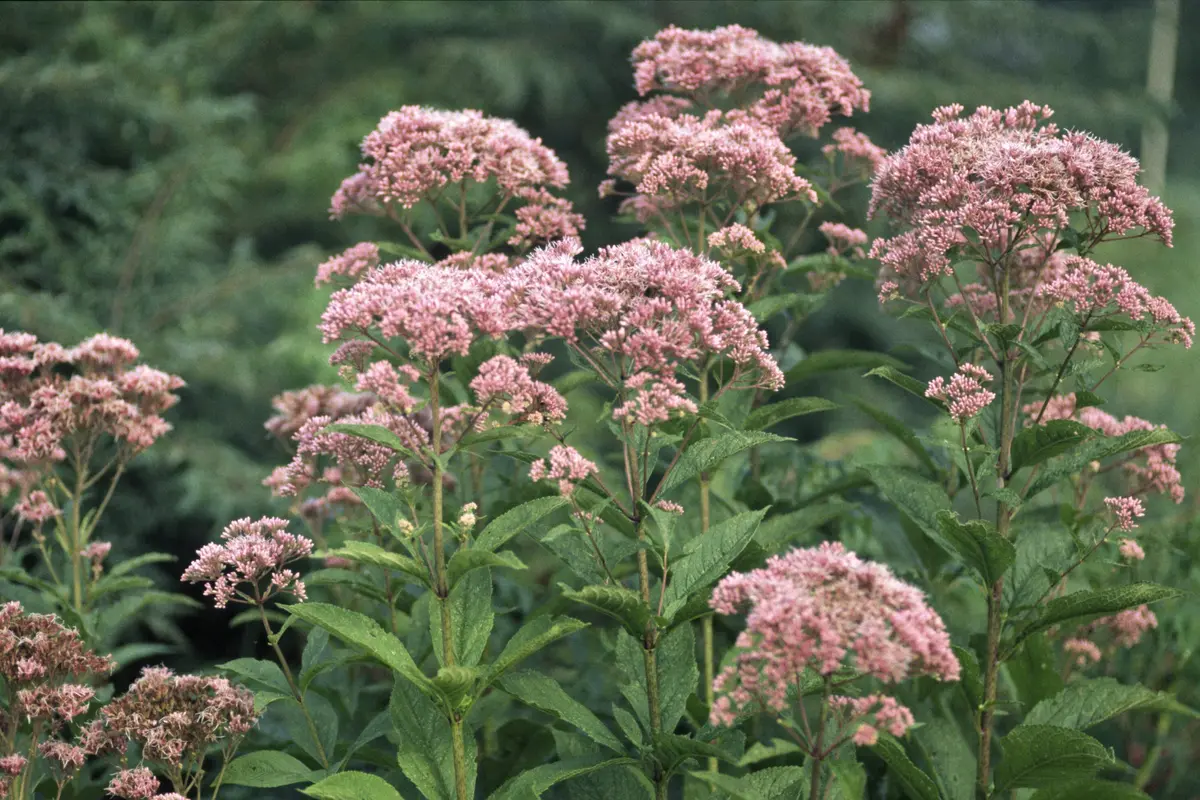
Joe-Pye Weed is a late summer flowering, North American perennial with fragrant, pale pink to pale purple flowers in large, domed clusters, and attractive seed heads in winter. This handsome North American member of the Aster family occurs naturally in low moist ground, moist wooded slopes, and savannas, and along streams from New Hampshire to Minnesota, Iowa, and Nebraska, and south to Florida and Georgia. Joe-Pye Weed was used in the garden as a large accent in the perennial border. The species was introduced to Europe by 1640 and listed in Philadelphia nurseryman John Bartram's catalogue in 1793. Also known as Gravel Root, Purple Boneset, and Hempweed, Native Americans used it as a diaphoretic to induce perspiration and break a fever and early settlers quickly adopted this practice.
Joe-Pye has large leaves in whorls around the stem and its late-season blooms attract swallowtail butterflies.
- Peggy Cornett, n.d.
Further Sources
- Griffith, Lawrence D. Flowers and Herbs of Early America. New Haven: Yale University Press, 2008.
- Leighton, Ann. American Gardens in the Eighteenth Century. Amherst: University of Massachusetts Press, 1986.
- Thomas Jefferson Center for Historic Plants.
In Bloom at Monticello is made possible by support from The Richard D. and Carolyn W. Jacques Foundation.