
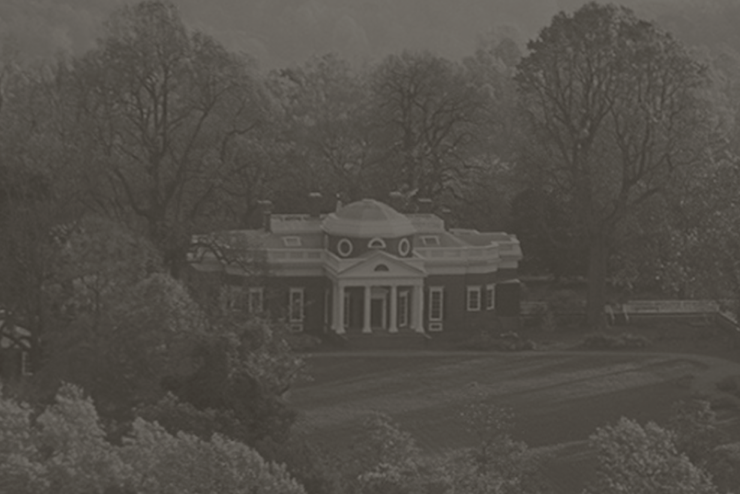
While historians have been quick to highlight the national reasons for Jefferson’s vocal support for the admission of Missouri, the situation at Monticello that shaped his thinking has been largely overlooked. In September 1819, Jefferson had agreed to be guarantor of two $10,000 loans for his friend Wilson Cary Nicholas, who promptly died the following year.

Two centuries ago, on February 13, 1819, James Tallmadge, a member of the Democratic-Republican Party formed by Thomas Jefferson, offered an amendment to a bill regarding the admission of the Territory of Missouri into the United States. The so-called Tallmadge Amendment proposed banning further imports of slaves into the future state, as well as the gradual emancipation of those already in the territory. What should have been a simple decision on the future of Missouri, however, soon became a debate on the future of

The Restoration Department recently brought in conservator Andy Compton to restore the composition ornament on the Hall fireplace mantel frieze.
Why the Virginia Statute for Establishing Religious Freedom is the key to political freedom and free thought.

Last week our Curatorial and Restoration teams joined forces for an important project: thoroughly cleaning Monticello from floor to ceiling. Affectionally (and accurately) dubbed the “Big Clean,” this annual event helps us preserve the house and prepare for a new year of visitors—but it’s also a lot of work.

On December 28, 1993, Monticello Getting Word historians Lucia "Cinder" Stanton, Dianne Swann-Wright, and Beverly Gray traveled to Chillicothe, Ohio to interview five members of the Pettiford family—three of whom were descendants of Madison Hemings.
“Rebellion to tyrants is Obedience to God” – We have come to think of this impassioned phrase as distinctly Jefferson, but there’s more to this story.

From writing the Declaration of Independence to commissioning the Louisiana Purchase, Thomas Jefferson is one of the most influential figures in our presidential history. But strides toward social and political freedom were not the only things he made relevant during his two terms. We have Jefferson's unique taste to thank for popularizing some of the most beloved foods in American culture—think ice cream, mac 'n' cheese and even french fries.

Before the era of Wii’s, Twitter, and Netflix, the Jefferson family entertained themselves with music, reading aloud, or scientific inquiry. As part of an ongoing campaign to restore Monticello’s interiors, curators recently acquired an air pump similar to Jefferson’s lost original.

In mid-September 1817, Thomas Jefferson was preparing to leave Poplar Forest and return home to Monticello, but he had a few errands to run first. He set off for Lynchburg, where he visited the shop of James Newhall and purchased what was perhaps his first and only pair of “ready-made” shoes. Unfortunately, they didn’t fit and Jefferson returned them with a somewhat exasperated note that got me to wondering: where did most people get their shoes, what did those shoes look like, and who made them?
