
Established in 1998, the Léonie Bell Rose Garden at the Center for Historic Plants (CHP) was made possible by a generous grant from Louis Bell in memory of his wife, the late rosarian, author and botanical illustrator Léonie Bell. Mrs. Bell's contributions to the knowledge of old roses, especially the class known as Noisettes, was critical to our preservation of these plants today. Detailing her own research and experiences in her Pennsylvania garden, she wrote countless articles on old roses for national and international societies such as the Heritage Roses Group, the American Rose Society and the Royal National Rose Society. Mrs. Bell was mentor to many prominent experts in the field, including Dr. Arthur O. Tucker of Delaware State University and Rev. Douglas Seidel of Emmaus, Pennsylvania. It was Rev. Seidel who arranged for many of the more rare Noisette specimens to be included in this garden, and even donated prized plants from his personal collection.
The story of the Noisette class of roses began at the dawn of the nineteenth century in Charleston, South Carolina, on the plantation of John Champneys. In Champneys’ garden two parent roses, the white European Musk and the deep rose-colored, repeat-blooming Old Blush China Rose, crossed to produce a very desirable offspring bearing clusters of pale pink flowers throughout the season with the sweet fragrance of the Musk. This rose, which he named ‘Champneys Pink Cluster,' traveled to France where rose breeder Louis Noisette went on to develop countless varieties from Champneys' seminal cross. Thus, the class was named after Noisette, even though it originated in a southern North American garden.
The Bell Garden was designed to tell the story of the rose breeding and development that ensued with this first American rose hybrid. It contains over sixty different Noisette, Musk and China roses, including many one-of-a-kind selections. Rev. Seidel generously donated what he called "two of Léonie's favorites:" Aunt Louisa Rose from the Ohio garden of President James Garfield's aunt and Faded Pink Monthly from Creek Side, the Maryland home of pioneer antique rose collector Ethelyn Emery Keays.
This garden, designed by landscape architect and historian C. Allan Brown, is reflective of 18th- and 19th-century Rosary Gardens, which were planted generally in a circular design creating an intimate enclosure of roses either festooning as garlands or freely flowering as bushes. The Bell Garden is in the shape of an octagon, one of Thomas Jefferson's favorite forms, with paths bisecting the center and surrounded by eight-foot posts connected with chains for the climbing sorts. CHP's former nursery manager, Diane Lowe, and Monticello's former master carpenter/jack-of-all-trades Dick Proffit are to be commended for their fine work in executing this project. Special thanks go also to Wayne Goodall, CHP's dedicated volunteer, for her ideas and always appreciated involvement.
In addition to Louis Bell's contribution toward the garden's construction, CHP has received support from members of the Heritage Roses Group, The Philadelphia Rose Society, and other individuals with a passion for rose preservation and enduring esteem for Léonie Bell.
| BED I | Intro Date | Type | History | Description |
| Buff Beauty | 1939 | Hybrid Musk | Bentall, breeder. | Apricot-buff, dble, Climber |
| Cécile Brünner, White | 1909 | Polyantha | Fraque, breeder. original sweetheart rose. | creamy white w/ lemon base |
| Champney's Pink Cluster | 1802-1811 | Noisette | First Noisette; John Champneys, Charleston, SC | light pink, clusters |
| Elizabeth Navorro | 2001 | Polyantha? | (source R. Moore via D. Seidel) | tiny pink |
| Mary Washington | n/a | Noisette | old form, grown at Mt. Vernon 100+ yrs | off white touched w/ pink |
| Emmie Gray | Found | China | Found in Bermuda, may be Redoute's R. chinensis species | crimson |
| Narrow Waters | 1883 | Musk | sport of Nastarana | blush pink |
| Nastarana | 1879 | Musk | Middle Eastern cv. introduced from Iran | white |
| Old Blush | 1752 | China | male Noisette parent, c. 1000 AD in China | rose red, semi-double, shrub |
| Old Blush, CL | n/a | China | climbing form of Old Blush | rose red, semi-double |
| "Old Grey Cemetery Noisette" | n/a | Noisette | From Doug Seidel, 2013 | bright pink |
| Rosa roulettii | 1800 | China | miniature, Canton; re-discovered, Switzerland | deep red semi double |
| "Ruth's Wavy Leaf Noisette" | n/a | Noisette | Ruth Knopf, found, Charleston, SC | pale pink |
| Single Moss Rose | n/a | Centifolia | very rare, single for of 18th c centifolia | rose pink |
| Single Pink China | ancient | China | likely the wild type from China | rose pink |
| "WalMart Noisette" | n/a | Noisette | found outside Walmart in Florida | medium pink, double |
| BED II | ||||
| "Aunt Louisa" | n/a | Noisette | fr. Pres. Garfield's Aunt Louisa's garden | pale pink, double |
| "Bremo Musk" | n/a | Musk | found at Bremo Recess; documented ca 1815 | dble & semi-dble white |
| "Chester Cemetery Noisette" | n/a | Noisette | From Doug Seidel, 2013 | deep pink with blush |
| Fabvier | 1832 | China | Laffay, breeder | cherry rose-red paling to pink |
| "Faded Pink Monthly" | n/a | Noisette | pre-Civil War rose found by Mrs. Keays | soft pink buds, double white blooms |
| Marie Pavié | 1888 | Noisette | seedling of older Noisette; Algatiere, breeder | pale pink to white; semi-dble |
| "Mt. Vernon Purple" | n/a | Noisette | syn. "Mrs. Wood's Lavender-Pink" | cerise, dble |
| Musk Rose, Single | ca. 1540 | Musk | original species-Eur. - Middle East | pure white, single flower |
| "Placerville White Noisette" | n/a | Noisette | found in Placerville Union Cemetery, | very double white |
| Princesse de Nassau | pre 1835 | Musk-Noisette | Laffay, breeder | soft pink-cream, dble, cupped |
| Rêve d'Or | 1869 | Tea-Noisette | Ducher intro. | golden yellow, shaded apricot |
| Zéphirine Drouhin | 1868 | Bourbon | Bizot, breeder. | bright pink-cerise, dble |
| BED III | ||||
| "Aunt Louisa" | n/a | Noisette | fr. Pres. Garfield's Aunt Louisa's garden | pale pink, double |
| "Cato's Pink Cluster" | n/a | Noisette | From Carl Cato's collection | pink clusters |
| Cécile Brünner, CL | 1894 | Polyantha | Hosp, breeder. Original sweetheart rose | blush pink climber |
| "Cross Manor Blush Noisette" | n/a | Noisette | Kopel home in Calvert Co. MD. | light pink, fully double |
| Fellenberg | 1835 | China Noisette | Tea/China/Noisette hybrid | bright crimson-magenta, dble |
| Lamarque | 1830 | Noisette | Marechal (Fr.), climbing | white with yellow undertones |
| Léonie Lamesch | 1899 | Polyantha hybrid | Noisette x polyantha. Lambert, breeder. | dark salmon pink; double |
| "Lingo Musk" | N/A | Noisette | found. | blush pink w/ rose edges |
| Louis Philippe | 1834 | China | Guerin, breeder. | crimson, dble |
| Mme. Laurette Messimy | 1887 | China-Tea | Guillot, breeder (France) | salmon pink; semi-double |
| Monsieur Tillier | 1891 | Tea | Alexandre Bernaix (France), breeder | carmine-red, ages to violet-red |
| "Natchitoches Noisette" | early 1800s | Noisette | found in Natchitoches, LA cemetery by Welch | pink blend, semi-dble, cupped |
| Old Blush, CL | n/a | China | climbing form of Old Blush | rose red, semi-double |
| Perle d'Or | 1884 | Tea Polyantha | similar to Cecile Brunner; Rambaux bred 1875 | golden pink buds to yellow |
| "Redouté Red" | n/a | China | study name for rose still found in Charleston, SC | |
| "Ruth's Tiny Polyantha" | n/a | Polyantha | found by Ruth Knopf | |
| "Temple Musk" | n/a | Musk | found, Hollywood Cemetery, Richmond, VA | fully double white |
| "Tufton Musk Seedling" | found | Musk | single musk x 'Rambling Rector' Multiflora rambler | |
| BED IV | ||||
| Belle Vichyssoise | 1858/1895 | Noisette | Bred by Moreau--'Cornelie'; intro by Lévêque | lt. pink clusters, dble |
| Blush Noisette | 1814 | Noisette | Philippe Noisette seedling from Champneys' | light pink, fully double |
| Bougainville | 1822 | Noisette | Vibert, breeder. | rose pink, quilled petals |
| Cécile Brünner | 1880s | Polyantha | cross w/ Mme. De Tartas | pale pink form |
| Céline Forestier | 1842 | Tea-Noisette | Trouillard, breeder | clear yellow w/ apricot, dble |
| Clotilde Soupert, CL | 1902 sport | Polyantha | similar to Bourbon roses | white w/ pale pink center, dble |
| Common Pink China | 1804 | China | first 'Old Blush' seedling sold in Paris | |
| Cramoisi Supérieur | 1832 | China | aka Agrippina; South TX | rich crimson, dble, cupped |
| Fellenberg | 1835 | China Noisette | Tea/China/Noisette hybrid | bright crimson-magenta, dble |
| "Fewell's Noisette" | n/a | Noisette | found. | blush pink; reddish canes |
| Hermosa | 1840 | China | Marchesseau, France. | Fully double, rose pink |
| "Hollywood Pink Cluster" | n/a | Noisette | found in Hollywood Cemetery, Richmond, VA | pale pink |
| La Biche | 1832 | Tea Noisette | M. Robert (France) syn. Mme de Sombreuil | white, salmon-pink shading |
| Marie Daly | modern | Polyantha | selected sport of Marie Pavié | medium pink, thornless |
| Mrs. B.R. Cant | 1901 | Tea | Benjamin R. Cant & Sons, United Kingdom, breeder | deep pink, lighter shading |
| "St. Leonard's Noisette" | n/a | Noisette | sold as 'Jean D'Arc'; Keays find Calvert Co. MD | |
| Wilmott's Crimson China | 1792 | China | aka White Pearl in Red Dragon's Mouth | bright red, dble, miniature |
A Selection of LBRG Roses
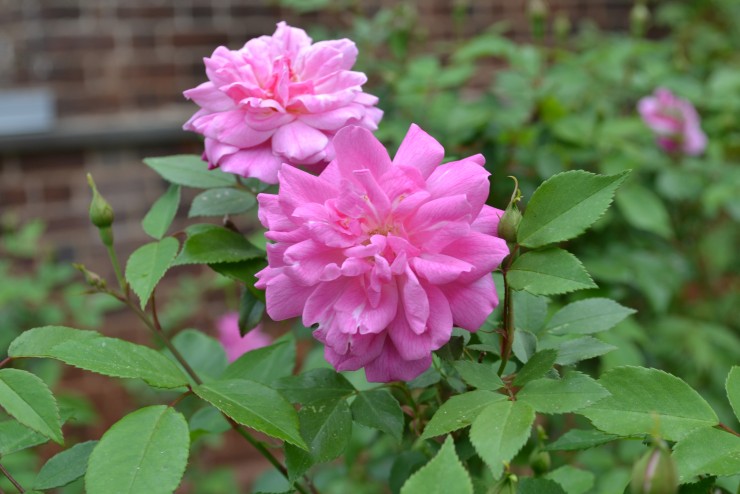
Old Blush China Rose, 1752 (photographed at Monticello)

European Musk Rose (Rosa moschata)

Cramoisi Superieur, 1832

La Biche, 1832
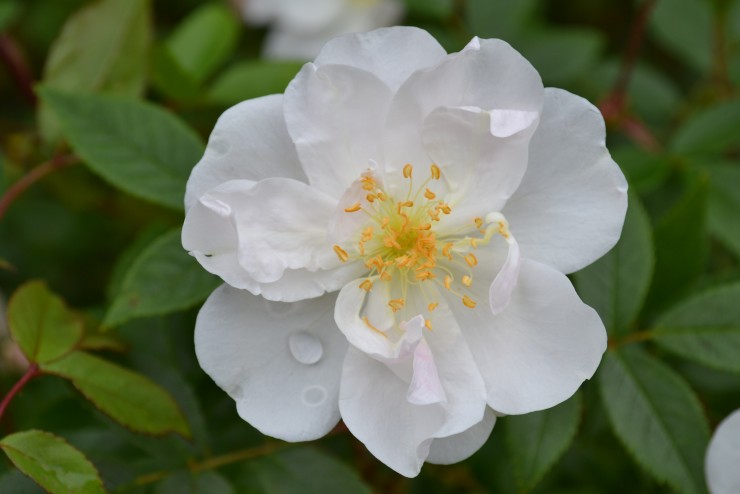
Nastarana, 1879

Reve d'Or, 1869

"Hollywood Pink Cluster," found in Hollywood Cemetery, Richmond, VA

Double Musk Rose (Rosa moschata plena)